Tuesday, April 17, 2012

Another Oil Price Shock, Another Global Recession?

Brent crude ended trading above $120 a barrel on Friday, April 13, while WTI crude on NYMEX for May delivery settled at $102.83 a barrel.  Oil has traded above $100 for all but a couple of days in the past year (see chart below).  This persistent high oil price has many concerned to start threatening a nascent recovery of the global economy.


Studies show that historically, around 90% of US recessions post World War II were preceded by oil price shocks.  The most recent occurrence took place when oil more than doubled in price from January 2007 to July 2008 due to a sharp increase in Chinese demand.  The pullback of US consumer and corporate spending already put a drag on economic growth before the subprime induced financial crisis closed the deal on the Great Recession.

Analysts generally see the $120-130 level as a price that would prompt consumer and corporate to cut back on spending sharply, and hurt the recovery and growth of key economic sectors. A recent Reuters survey of 20 equity strategists put $125 a barrel as the point economy and stock markets could start to suffer.

The most recent study on the link between oil price and economic recession came from energy industry consultancy Wood Mackenzie (WoodMac) published earlier this month.  The chart below from WoodMac illustrates "the mechanism" of how an oil price shock would derail the global economy. 


According to WoodMac's model,
".... the US will fall into recession within 12 months if WTI increases to $130 per barrel and the price remains elevated. If WTI reaches $150 per barrel and remains elevated, recession will be more pronounced with US GDP estimated to contract 0.4% in 2013."
U.S. domestic petroleum products are priced off of Brent since WTI has become a less relevant oil price marker due to the inventory glut at pipeline capacity challenged Cushing, OK depressing the WTI price.  So using the current spread between WTI and Brent of around $15-$20, WTI $130 would suggest Brent at about $150 range.  Brent futures already hit $128.40 a barrel, the highest since 2008, in early March, but has since given back some of the gains.. 

However, the difference between now and 2008 is that when oil spiked to almost $150 in 2008, there was a strong demand from China and a real shortage of supply, whereas the current world oil market is a lot more balanced than the current Brent oil price suggests.

IEA (International Energy Agency) said in its monthly report that there had potentially been a rise in global oil stocks of 1 million barrels per day (bpd) over the last quarter, and the impact on prices had not yet been fully realised.  Reuters quoted the IEA that:
"Easing first quarter 2012 fundamentals have seen prices recently lose most of the $5 per barrel they gained in March. The muted impact so far is partly because much of this extra supply has been stockpiled on land or at sea."
Rather than reflecting market fundamentals, dollar prices for Brent crude, up more than 15% this year, has been pushed up mainly by fears about Iran, and the loss of supply from three relatively small oil producing countries--Syria, Yemen and South Sudan--adding to the supply worries.  In other words, the oil price is bid up primarily by trading actions on the geopolitical factors (chiefly Iran). 

Meanwhile, Saudi Oil Minister Ali Al Naimi said on Friday, April 13 in a statement during a visit to Seoul that
“We are seeing a prolonged period of high oil prices. We are not happy about it. (The Kingdom of Saudi Arabia) is determined to see a lower price and is working towards that goal.” 
“Fundamentally the market remains balanced — there is no lack of supply.  Saudi Arabia has invested a great deal to sustain its capacity, and it will use spare production capacity to supply the oil market with any additional required volumes.”
Naimi earlier this year indicated $100 a barrel as an ideal price for producers and consumers earlier this year.

Chart Source: Reuters.com

Typically, oil price shock occurs when price goes out of the normal range.  Currently, oil is not trading at an unprecedented level as in the case of 2008, which is hard to hit given the projection of a subdued global GDP, weak oil demand outlook, and an eventual resolution of the Iran situation.

Thus we believe oil has gotten way ahead of itself, and could experience a correction later this year and in the next three years or so.  End user behavior change is starting to manifest, and the latest CFTC trading position reports already showed that money managers cut their net-long position roughly 12% in light, sweet crude-oil futures and options (see chart above).  (Brent already went down to $118.57 on Monday, April 16.)

So no, unless something totally unexpected shocks the oil price into no man's land, WTI and Brent are unlikely to hit the levels that could possibly bring about a global recession any time soon.  In fact, among the major possible drivers of a global recession, European economic and debt crisis looks to be the greater risk than an oil price shock. 


Posted courtesy of AsiaBlue at Econmatters

President Obama Looks into Oil Manipulation … Pure Political Theater

This is just pure political pandering to the masses. The world oil market does not just revolve around the US anymore. India and China are increasing players and are buying more oil in the world markets. It is the demand from the world for energy that is pushing prices higher, not the speculators.

And speaking of higher, crude oil [May contract] closed higher on Tuesday as it extended the rally off last week's low. The high range close sets the stage for a steady to higher opening on Wednesday. Stochastics and the RSI are bullish signaling that a low might be in or is near.

Closes above the 20 day moving average crossing at 104.25 are needed to confirm that a short term low has been posted. If May renews the decline off March's high, the 38% retracement level of the October-March rally crossing at 97.84 is the next downside target.

First resistance is the 20 day moving average crossing near 104.25. Second resistance is the reaction high crossing at 105.49. First support is last Tuesday's low crossing at 100.68. Second support is the 38% retracement level of the October-March rally crossing at 97.84.

Get 4 FREE Trading Videos from INO TV!

Get Maximum Yield With Commodity MLPs

Darren Schuringa, co-founder of Yorkville Capital, discusses how to invest in commodity MLPs and why they have such attractive yields.


How To Trade Market Sentiment

Monday, April 16, 2012

Crude Oil Up on Weaker Dollar, Seaway Pipeline News

Crude oil rose as the reversal date for the Seaway crude pipeline was moved up, causing the spread between New York traded futures and Brent in London to narrow. The bulls also gained support from retail sales in the U.S. increased more than forecast in March.

Oil closed up $0.16 a barrel at $102.99 today. Prices closed nearer the session high today and saw more short covering and bargain hunting. A lower U.S. dollar index supported crude today. However, a six week old downtrend line is still in place on the daily bar chart. Bulls and bears are on a level near term technical playing field.

Gold futures closed down $11.20 an ounce at $1,649.00 today. Prices closed near mid range today as the bulls are fading again. Bears are working on re establishing a six week old downtrend on the daily bar chart. The bears have regained the slight near term technical advantage.

Natural gas closed up 3.6 cents at $2.016 today. Prices closed nearer the session high today and saw tepid short covering in a bear market. Prices Friday hit a contract and 10 year low. The bears have the solid overall near term technical advantage. There are no early clues to suggest a market low is close at hand.

The U.S. dollar index closed down 33 points at 79.72 today. Prices closed nearer the session low today. Bulls and bears are on a level near term technical playing field amid choppy and sideways trading. Bulls' next upside price breakout objective is to close prices above solid technical resistance at the April high of 80.38.

How To Tell Where Other Traders Have Placed Their Buy and Sell Orders

Sunday, April 15, 2012

ONG: Gold Weekly Technical Outlook For Sunday April 15th

Gold's rebound last week was limited at 1681.3 and retreated. With 4 hours MACD crossed below signa line, initial bias is mildly on the downside this week. Also, note that with 1696.9 resistance intact, near term outlook remains bearish and fall from 1792.7 is expected to resume sooner or later. Break of 1613 will target 1523.9 and possibly below.

In the bigger picture, price actions form 1923.7 high are viewed as a medium term consolidation pattern. Fall from 1792.7 is viewed as one of the falling leg inside the pattern and should head back to 1478.3/1577.4 support zone. Nonetheless, we'd still expect strong support from 1478.3/1577.4 support zone to contain downside to finish the consolidation and bring up trend resumption to another high above 1923.7 eventually. On the upside, break of 1696.9 resistance will now argue that fall from 1792.7 is finished and turn focus back to this resistance instead.

In the long term picture, with 1478.3 support intact, there is no change in the long term bullish outlook in gold. While some more medium term consolidation cannot be ruled out, we'd anticipate an eventual break of 2000 psychological level in the long run

Comex Gold Continuous Contract 4 Hour, Daily, Weekly and Monthly Charts

Check out our latest Video, Market Analysis and Forecast for the Dollar, Crude Oil, Gold, Silver, and the SP500

Friday, April 13, 2012

Crude Oil Ends The Week on a Sour Note

Crude oil [May contract] closed lower on Friday ending a two day bounce off Tuesday's low. The low range close sets the stage for a steady to lower opening on Monday. Stochastics and the RSI are turning neutral to bullish signaling that a low might be in or is near. Closes above the 20 day moving average crossing at 104.69 are needed to confirm that a short term low has been posted. If May extends the decline off March's high, the 38% retracement level of the October-March rally crossing at 97.84 is the next downside target. First resistance is the 20 day moving average crossing near 104.69. Second resistance is the reaction high crossing at 105.49. First support is Tuesday's low crossing at 100.68. Second support is the 38% retracement level of the October-March rally crossing at 97.84.

Natural gas [May contract] closed slightly higher due to light short covering on Friday. The high range close sets the stage for a steady to higher opening on Monday. Stochastics and the RSI are oversold but remain neutral to bearish signaling that sideways to lower prices are possible near term. If May extends the multi year decline, monthly support crossing at 1.960 is the next downside target. Closes above the 20 day moving average crossing at 2.218 are needed to confirm that a short term low has been posted. First resistance is the 10 day moving average crossing at 2.078. Second resistance is the 20 day moving average crossing at 2.218. First support is today's low crossing at 1.959. Second support is monthly support crossing at 1.620.

Gold [June contract] closed lower on Friday and the low range close sets the stage for a steady to lower opening on Monday. Stochastics and the RSI are neutral to bullish signaling sideways to higher prices are possible near term. Closes above last Monday's high crossing at 1685.40 are needed to confirm that a short term low has been posted. If June extends the decline off February's high, the 75% retracement level of the December-February rally crossing at 1595.00 is the next downside target. First resistance is last Monday's high crossing at 1685.40. Second resistance is the reaction high crossing at 1699.60. First support is last Wednesday's low crossing at 1613.00. Second support is the 75% retracement level of the December-February rally crossing at 1595.00.

Get Your FREE Preview of INO TV

Thursday, April 12, 2012

EIA: U.S. Imports of Nigerian Crude Oil Have Continued to Decline in 2012

The trend of declining crude oil imports into the United States continued in the first month of 2012. There has been a particularly sharp decline in imports from Nigeria due to the idling in late 2011 of two refineries on the East Coast, which were significant buyers of Nigerian crude, and reduced imports by refiners on the Gulf Coast. Prior to the idling of the refineries, Nigeria typically accounted for about 10% of the crude oil imported into the United States; in January, that share dropped to about 5%.

graph of Monthly regional U.S. crude oil imports from Nigeria, January 2005 - January 2012, as described in the article text

 In January 2012, imports from Nigeria totaled just 449 thousand barrels per day (bbl/d), a 54% (519 thousand bbl/d) decrease from January 2011, marking the lowest monthly import total from the country since 2002. One third of this decline was the result of two idled Philadelphia area refineries. ConocoPhillips' Trainer refinery (idled in September 2011) and Sunoco's Marcus Hook refinery (idled in December 2011) imported a combined 173 thousand bbl/d of Nigerian crude in January 2011. Most of the remaining decrease in Nigerian imports was the result of several Gulf Coast refiners reducing Nigerian imports in favor of domestically produced crude.

The idled refineries were suited to run light-sweet crude oils, and Nigerian crude oils tended to match well with that requirement. However, because of their quality, Nigerian crude oils are often expensive compared to heavier or more sour crude oils used by many of the Gulf Coast refineries.

 Additionally, Nigerian crudes are currently expensive compared to some of the inland domestic light sweet crudes of similar quality such as West Texas Intermediate (WTI), Bakken, and Eagle Ford. Given the growing production from the Bakken and Eagle Ford formations and associated transportation constraints, these inland crudes have been selling at a discount to waterborne crudes on the Gulf Coast, providing refiners in that area further incentive to switch from imported crude to inland, domestically produced crude when available.

Preliminary weekly data indicate the trend of decreasing Nigerian imports continued in February and March with March imports averaging just 301 thousand bbl/d, which, if confirmed in the monthly data, would represent a 64% decrease compared to March 2011.

Check out our latest Video, Market Analysis and Forecast for the Dollar, Crude Oil, Gold, Silver, and the SP500

Wednesday, April 11, 2012

Crude Oil, Natural Gas and U.S Dollar Commentary For Wednesday Evening

Crude oil [May contract] closed up $1.59 a barrel at $102.63 today. Prices closed nearer the session high today and saw short covering after prices Tuesday hit a seven week low. A weaker U.S. dollar index supported crude today. A five week old downtrend line is still in place on the daily bar chart. Bulls and bears are on a level near term technical playing field.

Gold futures [June contract]closed down $1.70 an ounce at $1,659.00 today. Prices closed near mid range in quieter, consolidative trading. The key outside markets were in a bullish posture today, as the U.S. dollar index was weaker and crude oil prices were higher. That did limit the downside in gold today. The bears still have the slight near term technical advantage in gold. A five week old downtrend is in place on the daily bar chart.

Natural gas [May contract] closed down 4.4 cents at $1.987 today. Prices closed near the session low again today and hit another fresh contract and 10 year low today. The bears have the solid overall near term technical advantage. There are no early clues to suggest a market low is close at hand.

Get Today's 50 Top Trending Stocks

Tuesday, April 10, 2012

Crude Oil Falls on a Decline in China's Fuel Imports and Speculation on U.S. crude Stockpiles

Crude oil [May contract] closed lower for the second day in a row on Tuesday due to a decline in China's fuel imports and speculation that U.S. crude stockpiles rose to the highest in 22 years raised concern of slowing global demand.

The low range close sets the stage for a steady to lower opening on Wednesday. Stochastics and the RSI are neutral to bearish signaling that sideways to lower prices are possible near term.

If May extends the decline off March's high, the 38% retracement level of the October-March rally crossing at 97.84 is the next downside target. Closes above the 20 day moving average crossing at 105.18 are needed to confirm that a short term low has been posted.

First resistance is the 10 day moving average crossing near 103.62. Second resistance is the 20 day moving average crossing at 105.18. First support is today's low crossing at 100.68. Second support is the 38% retracement level of the October-March rally crossing at 97.84.

How to Use Money Management Stops Effectively

Chesapeake Energy, one Natural Gas Producer That's Taking the Road Less Traveled

Chesapeake Energy [CHK] is one natural gas producer taken the road less traveled by entering 2012 "naked" with none of its gas volumes hedged, betting that gas prices would rise.  Exiting the positions was profitable, but could prove to be short sighted and misguided by over confidence as it essentially left the company fully exposed to the languishing commodity price, while aggravating its already tight liquidity ratios (both current and quick ratios stood at 0.4x as of Dec. 31, 2011).  In contrast, other natural gas companies, like Encana, Linn Energy, Venoco and Range Resources  have hedged at least 75% of their 2012 production.

Henry Hub natural gas price has tanked 48% to a 10 year low in the past twelve months closing at $2.11 per mcf as of Monday, April 9.  Record production from new shale plays aided by new technology such as horizontal drilling and hydraulic fracturing ("fracking"), a sluggish U.S. economy, and a much warmer than normal winter have all conspired to depress the the price the natural gas since 2009.

Chart Source: FT.com, April 9. 2012

The situation could get even worse this year. 

The latest data from EIA showed that working gas in storage rose by 42 billion cubic feet (Bcf) to 2,479 Bcf as of Friday, March 30, 2012 hitting an all time high for March month for the week ended March 30, 2012.  This is 56% higher than last year at this time, and 60% or 934 Bcf above the 5 year average of 1,545 Bcf (see chart below).


NOAA announced that March 2012 is already the warmest March on record for the contiguous United States, a record that dates back to 1895 (See Map Below).  A warm winter does not necessarily guarantee a very hot summer, which is one way to burn off some of the gas inventory glut.


Analysts at Barclays estimate the average cost of drilling for domestic natural gas is roughly $4, but may be as low as $2.50 or so in easier to drill plays like the Marcellus Shale in the Appalachian region.  That suggests  almost all the new drilling of unconventional plays are under water at the current Henry Hub price level.

Producers are feeling the pain.  Companies including ConocoPhillips, Chesapeake Energy, Encana, Ultra Petroleum, Talisman Energy have shut in production and/or cut their 2012 capital budget.  However, these planned curtailments most likely will not be enough to balance out the massively over supplied market.

In its March 2012 Short term Energy OutlookEIA now expects inventory levels at the end of October in both 2012 and 2013 will set new record highs as well.  At this rate, some analysts are projecting storage capacity could be close to max out by October of this year.  In an extreme case, with no storage space available, some produced natural gas may get dumped on the spot market, and we could see natural gas breaking below the $2 mark this year

Chart Source: Yahoo Finance, April 9, 2012
In this challenging commodity price environment, producers with the better risk and portfolio management skill would likely weather the storm better than peers, while companies like Chesapeake Energy may have to bite its time as well as bullet.  Chesapeake Energy stocks have dropped about 37% in the past 12 months vs. +4.07% of S&P 500 in the same period (see chart above). 


Posted courtesy of Econmatters


FREE Trade School Video “The Fibonacci Tool Fully Explained”

Monday, April 9, 2012

Gold Prices Are Set for Further Decline

In the not so distant past arguing that precious metals prices were setup to fall generally elicited a response which was not real pleasant. In fact, during gold’s infamous bull market rally on several occasions I called for pullbacks which regardless of the accuracy of my call generated hate mail that seemingly never ended.


Fast forward to the present and hardcore gold bugs remain transfixed on the idea that precious metals must rise. The gold bull market has ended, at least for now and those still holding the bag are looking at large losses from the all time highs set back in 2011.
These same gold bugs will cite a litany of reasons why gold should be moving higher from the unprecedented printing of money by global central banks to the deficit spending and eventual fiscal day of reckoning facing most Western nations. I do not disagree with the gold bugs that in the long run gold prices will rally above the all time highs, but in the short to intermediate term there are several forces which have the potential to drive gold prices lower.
Gold prices cannot rise continually,regardless of the macro-economic backdrop. Nothing, not even Apple Computer (AAPL) or Priceline.com (PCLN) will rise forever. Eventually prices will come back down to earth and revert to the long term mean. It has happened in gold and it will happen to Apple Computer and Priceline.com at some point in the future, it is simply a matter of time.
Before I discuss my reasoning as to why gold and silver are likely to pullback in the intermediate term, I need to remind readers that I remain long term bullish of precious metals. While the long term remains bright, the short term is especially murky and dark.
The first primary concern for gold bugs should be the price behavior of the U.S. Dollar Index recently. The Dollar has rallied sharply higher after carving out a higher low on the daily chart (bullish). The Dollar is on the verge of breaking out above a major descending trendline on the daily chart. Once that breakout to the upside has occurred it will become likely that the recent highs will be tested and possibly taken out. The daily chart of the Dollar Index is shown below.

Dollar Index Daily Chart

The U.S. Dollar’s price action shown above is not indicative of bearish expectations. In fact, I would argue that the Dollar is, and likely will remain in a bull market in the short and intermediate time frames. However, it is important to recognize that strong periods of volatility will persist as Ben Bernanke and the Federal Reserve will continue to try to break the Dollar’s rally as it tries to grind higher.
The Federal Reserve hates deflation, and a stronger Dollar will push risk assets like equities lower and right now that is not part of the Federal Reserve’s election playbook. QE III will likely be announced at some point in the future as an attempt to break the Dollar’s rally and to put a floor underneath stock prices.
The Federal Reserve has used QE I and QE II to help prevent economic disaster. Recently “Operation Twist” has also been used to increase liquidity while keeping the bullish game going. Low interest rates and additional easing adjustments have staved off disaster before and they will likely be utilized again by the Federal Reserve.
Ultimately the free market and cycles will exert their will and the Federal Reserve will be left helpless. The day where monetary easing has no major impact is coming, but we are not quite there just yet.
In addition to the strength in the Dollar Index, the gold miners have been under major selling pressure. In fact, the gold miners have recently broken down out of a major consolidation zone that will likely lead to lower prices in the near term.
Unless gold miners can regain the breakdown level on a major reversal this coming week, the most we can hope for is a backtest of the support trendline sometime in the near future once the miner’s become significantly oversold. The weakness in the miners is just another example as to why lower prices for gold appear to be likely in the short to intermediate time frames. The weekly chart of the gold miners ETF is shown below.

Gold Miner’s (GDX) Weekly Chart

The gold miners are likely to lead equity markets lower in the near term, but lower prices for gold miners is certainly not positive for gold either. Obviously there are several economic factors which could still see gold prices working higher such as a collapse of the Eurozone, however at this moment the likelihood of that outcome in the short to intermediate term is not likely.
The European Central Bank and the Federal Reserve are not going to give up that easily. The process of admitting defeat will take time and global central banks will print money until they feel they have papered over the issue. It is the culmination of either QE III or other monetary easing around the world that will eventually move gold back above the all time highs. Unfortunately the short term price action of gold will most certainly remain under selling pressure barring any major unexpected announcements. The daily chart of gold futures is shown below.

Gold Futures Daily Chart

As shown above, I believe that short term targets to the downside are likely somewhere in the 1,475 – 1,525 price range. I think gold will find a major bottom near these levels and a strong bounce will play out. For long term buyers, I would take advantage of the forthcoming pullback. However, I would be mindful that further selling is quite possible before gold finds a major bottom.
As I said before, the longer term is bright for gold. However, the short to intermediate term will likely see more selling pressure. Until either the Dollar tops or some form of major quantitative easing is announced, I would anticipate lower prices in the yellow metal.
In the near term gold does not look attractive, but the longer term the catalysts for a major move above recent highs are present. The real question has become when and where will the Dollar top? When the Dollar tops and gold finds a major bottom, the potential for a monster move higher will become likely.
Until then, risk remains high.

Looking for a Simple ONE Trade Per Week Trading Strategy?
If So Join www.Option Trading Signals.com today with our 14 Day Trial

J.W. Jones

Can Crude Oil Bulls Rebound off of Mondays High Range Close

Crude oil [May contract] closed lower on Monday however the high range close sets the stage for a steady to higher opening on Tuesday. Stochastics and the RSI are neutral to bearish signaling that sideways to lower prices are possible near term.

If May extends the decline off March's high, the 38% retracement level of the October-March rally crossing at 97.84 is the next downside target. Closes above the 20 day moving average crossing at 105.47 are needed to confirm that a short term low has been posted.

First resistance is the 10 day moving average crossing near 104.20. Second resistance is the 20 day moving average crossing at 105.47. First support is today's low crossing at 100.81. Second support is the 38% retracement level of the October-March rally crossing at 97.84.


Let's take a look at today's "50 Top Trending Stocks"

A Big Mea Culpa About Seadrill's [SDRL] Dividend

From guest blogger Kevin McElroy........

On March 22, 2012 I wrote an article about what I perceive to be a potential danger to investors: a dividend trap. The premise of the article is simple: investors are starved of yield - by design of the Treasury and the Federal Reserve - and Wall Street knows it. So Wall Street will likely conspire to inflate yields to draw investors into stocks.
I pointed out that famed market guru Bruce Krasting noted a tendency of companies to pay dividends from debt. He wrote: "These are referred to as Dividend Deals. The borrower takes on new debt in order to pay a stock dividend to common shareholders. (I prefer to see dividends paid from cash flow from operations, not new debt.)"
I then made a big and frankly pretty stupid mistake with reference to an example of such a company. I talked about Seadrill (NYSE: SDRL), a deep sea driller that pays a substantial dividend with a high level of debt. But I then incorrectly pointed out that Seadrill pays out MORE in dividends than it makes in earnings. I made a mistake of not really digging through the relevant SEC reports to double check my premise.
In hindsight using SDRL as an example of a debt funded dividend payer wasn't the right choice. The metric I was looking at was the company's dividend payout ratio, which based on EPS looks tenuous at best. But as some readers have suggested, a look at cash flow suggests the dividend is more reliable.
One of the keys to Seadrill's dividend success in the future is that the debt to fund expansion of new rigs appears to promise continued growth and sustainable cash flows. This debt vs. growth conversation gets into a broader discussion than I had intended with the article so I won't get into the details.
But I do stand by my point that investors need to be wary about chasing yield and do their homework to understand where those dividends are coming from - my Seadrill faux-pas being just the latest relevant (and professionally embarrassing) example of how easy it is to make foolhardy assumptions about the relevant details.
So let my mistake serve as a lesson to really make sure a company can afford to sustain its dividend.
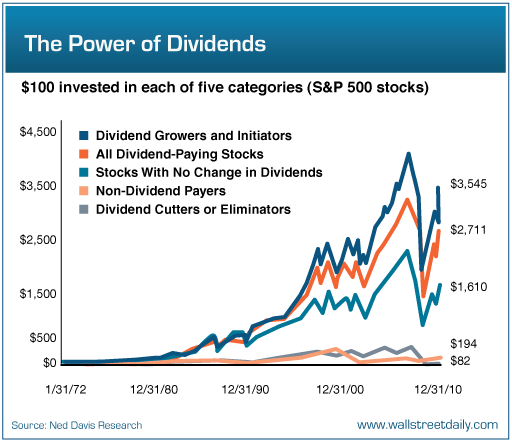
For a final warning of how dangerous it can be to chase yield, take a look at this chart plotting dividend cutters against other classifications of dividend companies:
(click to enlarge)
Being the owner of a dividend cutter essentially means losing money over the long term. So you should avoid companies that have any potential whatsoever of cutting their dividend.
Be careful out there. It's easy to make mistakes. And they're usually expensive.

Follow Kevin's post at Seeking Alpha

Get today's 50 Top Trending Stocks

Sunday, April 8, 2012

Don’t Count Your Easter Eggs Before They Hatch and do not Count......

From guest blogger Phil Flynn......

Don’t count your Easter eggs before they are hatched and do not count your barrels of oil until they come into port. A supply side surge in oil and a seemingly faltering Eurozone sent oil prices crashing back down to earth. The Energy Information Administration sent oil on a big ride by reporting that U.S. commercial crude oil inventories increased by 9.0 million barrels from the previous week. At 362.4 million barrels, U.S. crude oil inventories are above the upper limit of the average range for this time of year.

The build came after a surge of delayed imports. The EIA reported that U.S. crude oil imports averaged nearly 9.8 million barrels per day last week, up by 505 thousand barrels per day from the previous week. Over the last four weeks, crude oil imports have averaged about 9.0 million barrels per day, 59 thousand barrels per day above the same four week period last year. We saw a supply surge into the Gulf Coast as all of the crude that was lost in the fog showed up all at once. We also saw supply increase into Cushing, Oklahoma.

In an excellent article the EIA says that, “Crude oil inventories at the Cushing, Oklahoma storage hub, the delivery point for the NYMEX light sweet crude oil futures contract, have risen by 12.0 million barrels (43%) between January 13, 2012 and March 30, 2012. This was the largest increase in inventories over an 11 week period since 2009. The inventory builds can be partly attributed to the emptying of the Seaway Pipeline, which ran from the Houston area to Cushing, in advance of its reversal. While Cushing inventories are now approaching the record levels of 2011, the amount of available storage capacity at Cushing is much greater now than it was a year ago, relieving some of the pressure on demand for incremental storage capacity.

Historically, the Seaway Pipeline delivered crude oil from the U.S. Gulf Coast to Cushing, where it then moved to the refineries connected by pipeline to the storage hub. In November 2011, Enbridge Inc. acquired a 50% share in the pipeline from ConocoPhillips; at this time, Enbridge and joint owner Enterprise Product Partners announced they would reverse the direction of the pipeline to flow from Cushing to the Gulf Coast. Currently, the pipeline is expected to deliver 150,000 barrels per day (bbl/d) from Cushing to the Gulf Coast beginning in June 2012. The companies plan to expand Seaway's capacity to 400,000 bbl/d in 2013 and to 850,000 bbl/d in 2014."

"In early March, approximately 2.2 million barrels from the Seaway pipeline was emptied into Cushing storage in order to prepare for the pipeline's reversal. This accounts for about 20% of the build in inventories during this period. However, even without the emptying of Seaway, inventory builds over the past months have been particularly steep compared to the five year average. As of January 13, Cushing inventories stood at 28.3 million barrels, slightly below their seasonal five year average. After the 12.0 million barrel increase, inventories were almost 11 million barrels above their average level, the largest such variation to average since June 2011. This is largely due to flows into Cushing as a result of increasing production in the mid-continent region."

If you thought the euro crisis was solved with the Greek bailout then you were counting your Easter Eggs before they were hatched. Of course oil will focus on demand and the fear it may slow. The euro zone looks like it is headed back into a crisis. Weaker than expected data and concerns about Spain. A weak Spanish bond auction is raising fears that Spain is on a path to economic crisis bringing the EU and the world down with it. Here we go again.


Phil can be reached at 800-935-6487 or email him at pflynn@pfgbest.com

Check out our latest Video, Market Analysis and Forecast for the Dollar, Crude Oil, Gold, Silver, and the SP500

Friday, April 6, 2012

EIA: Spot Crude Prices Near 12 Month High, Natural Gas and Power Prices Near 12 Month Low

Key wholesale energy price benchmarks for crude oil, natural gas, and electric power reflect contrasting trends over the past year. International events have contributed to higher wholesale crude oil prices, whereas high levels of domestic natural gas production coupled with mild weather and record storage inventories have lowered wholesale natural gas prices. Because natural gas remains the marginal fuel in most electric power markets and because low heating and cooling demand in recent weeks have reduced electricity demand, electric power prices remain low as well. The figures above compare recent weekly price ranges (for March 29, 2012 - April 4, 2012) to the range of wholesale prices during the past year.


graph of Daily spot prices, weekly and yearly ranges, as described in the article text


graph of Daily spot prices, weekly and yearly ranges, as described in the article text


graph of Daily spot prices, weekly and yearly ranges, as described in the article text

Thursday, April 5, 2012

Crude Oil Gets a Lift From Job Report

Crude oil [May contract] closed higher due to short covering on Thursday as it consolidates some of Wednesday's decline. The high range close sets the stage for a steady to higher opening on Friday. Stochastics and the RSI are turning neutral hinting that a low might be in or is near.

Closes above the 20 day moving average crossing at 105.73 are needed to confirm that a short term low has been posted. If May extends the decline off March's high, the 38% retracement level of the October-March rally crossing at 97.84 is the next downside target.

First resistance is the 10 day moving average crossing near 104.63. Second resistance is the 20 day moving average crossing at 105.73. First support is Wednesday's low crossing at 101.88. Second support is the 38% retracement level of the October-March rally crossing at 97.84.

We are looking at a possible positive divergence for crude oil using the Williams% R indicator. Yesterday’s move in the May crude oil gave us a perfect 61.8% Fibonacci retracement for this contract. We expect this market to regroup and consolidate around current levels. Longer term we remain positive given the fact that our monthly Trade Triangle is in a green positive mode.

We are looking for crude oil to make its highs probably somewhere in the April/May period. With a trading score of -60 this commodity is currently in trading range. Long term traders should remain long this market with appropriate money management stops.

Check out Thursdays video and get a jump on next weeks trading.


Try MarketClub for 30 Days for just $8.95 - Click Here!

Has Gold Embraced it’s Fibonacci Number and Began to Base Out?

Is it safe to start buying Gold Stocks yet?

Yesterday the gold market pulled back into a perfect 61.8% Fibonacci retracement. We expect this market to begin to regroup around current levels between $1600 and $1620. With a trading score of -90 the gold market is in a strong downward trend. Look for resistance to come in between $1680 and the $1700 level. With all three of our Trade Triangles negative for gold we expect this market to remain on the defensive. Long term and intermediate term traders should be in short positions in gold with appropriate money management

But despite that gold [April contract] posted an inside day with a higher close on Thursday as it consolidated some of the decline off February's high. The high range close sets the stage for a steady to higher opening on Friday. Stochastics and the RSI are turning bearish signaling that sideways to lower prices are possible near term.

If April extends the decline off February's high, the 75% retracement level of the December-February rally crossing at 1592.70 is the next downside target. Closes above Monday's high crossing at 1682.80 would confirm that a short term low has been posted.

First resistance is Monday's high crossing at 1682.80. Second resistance is the reaction high crossing at 1696.90. First support is Wednesday's low crossing at 1612.30. Second support is the 75% retracement level of the December-February rally crossing at 1592.70.

We show you where we think this precious metal is headed in today’s video.

Wednesday, April 4, 2012

Is it safe to start buying Gold Stocks yet?

From guest blogger David A BanisterActive Trading Partners.com


One of the most common questions I field from my forecast and trading subscribers is can we buy Gold stocks yet? We have seen Gold consolidating and correcting following a 34 fibonacci month rally that I discussed last fall was going to top out around 1900 per ounce. This type of rally went from October of 2008 to August of 2011 and we saw Gold rally from $680 to $1900 per ounce during that time.
In order to work off the bullish sentiment that was at parabolic extremes, Gold is required to spend a reasonable amount of time in relation to the prior 34 month move to wash out the sentiment and create a strong pivot bottom. While this continues, the Gold stock index has taken it on the chin as money rotates out and into other hot areas like Technology and the Internet 2.0 social media boom. To wit, the GDX ETF peaked out last fall around 67 and current trades under 47 as of this writing.
However, there may be a silver lining developing in those dark mining stock clouds very soon. It does appear that we are in the 5th and final wave of this pessimistic decline in Gold stocks per my GDX ETF chart below. A typical bottoming pattern ends after 5 clear waves have taken place, and in this case I have targets between $43-$47 per GDX share for a likely pivot low in Gold stocks. Contrarian investors may do well to begin picking the better names in the sector and “scaling in” over the next short period of time.
Gold itself has recently corrected from 1793 per ounce to 1620 in the last several weeks. This has spooked the crowd out of Gold and put further pressure on the Gold mining stocks as well. Should Gold hold the $1620’s area and rebound past $1691 you will see the Gold stocks take off just ahead of that and from these 43-46 levels on the GDX ETF provide very strong returns to investors with the iron stomachs.
The best way to make money long term in the market and to grow your capital is to develop a method where you can define your risk levels within reason near the apex of a downside move, and then scale into that final apex and catch the rally on the upside. This is difficult to do but at my ATP service we have developed a strong methodology that takes advantage of “herd behavioral characteristics” and takes advantage of typical panic selling and panic buying to do just the opposite. We have not yet bought into the Gold Stock sector but I assume fairly soon we will be dipping our toes in the water while others have all rushed out of the sector right near the apex lows.
Take a look at Davids MRM method
Consider joining us for 90 days trial period and play along.  We provide all the alerts in real time via Email and internet posting. We provide daily updates on all positions and 24/7 Email access to me for any questions.Learn more and sign up at Active Trading Partner.com

Did a “bearish divergence” yesterday signal a top for the equity markets?

Crude Oil pulls back....is this a buying opportunity? We analyze where this energy market is headed.

Gold crashes....no surprise for MarketClub members. We show you where we think this precious metal is headed in today’s video.


Try MarketClub for 30 Days for just $8.95 - Click Here!

Cushing Crude Oil Inventories Rising in 2012

Crude oil inventories at the Cushing, Oklahoma storage hub, the delivery point for the NYMEX light sweet crude oil futures contract, are up by 12.0 million barrels (43%) between January 13, 2012 and March 30, 2012. This was the largest increase in inventories over an 11 week period since 2009. The inventory builds can be partly attributed to the emptying of the Seaway Pipeline, which ran from the Houston area to Cushing, in advance of its reversal. While Cushing inventories are now approaching the record levels of 2011, the amount of available storage capacity at Cushing is much greater now than it was a year ago, relieving some of the pressure on demand for incremental storage capacity.

graph of Weekly commercial crude oil inventories at Cushing, Oklahoma, as described in the article text

 Historically, the Seaway Pipeline delivered crude oil from the U.S. Gulf Coast to Cushing, where it then moved to the refineries connected by pipeline to the storage hub. In November 2011, Enbridge Inc. acquired a 50% share in the pipeline from ConocoPhillips; at this time, Enbridge and joint owner Enterprise Product Partners announced they would reverse the direction of the pipeline to flow from Cushing to the Gulf Coast. Currently, the pipeline is expected to deliver 150,000 barrels per day (bbl/d) from Cushing to the Gulf Coast beginning in June 2012. The companies plan to expand Seaway's capacity to 400,000 bbl/d in 2013 and to 850,000 bbl/d in 2014.

In early March, approximately 2.2 million barrels from the Seaway pipeline was emptied into Cushing storage in order to prepare for the pipeline's reversal. This accounts for about 20% of the build in inventories during this period. However, even without the emptying of Seaway, inventory builds over the past months have been particularly steep compared to the five year average. As of January 13, Cushing inventories stood at 28.3 million barrels, slightly below their seasonal five year average. After the 12.0 million barrel increase, inventories were almost 11 million barrels above their average level, the largest such variation to average since June 2011. This is largely due to flows into Cushing as a result of increasing production in the mid-continent region.


Don't miss today's 50 Top Trending Stocks

Tuesday, April 3, 2012

Sale of Provident Energy to Pembina Pipeline is Complete

Long time COT [Crude Oil Trader] fund favorite Provident [ticker PVX] has made way for the recent sale to Pembina Pipeline, ticker PBA. Pembina announced on January 16, 2012 that it has entered into an agreement with Provident Energy for Pembina to acquire all of the issued and outstanding common shares of Provident by way of a plan of arrangement under the Business Corporations Act (Alberta) to create an integrated company that will be a leading player in the North American energy infrastructure sector. The acquisition closed as of April 2, 2012.

What does this mean for Provident owners? From MarketWatch, U.S. listed shares of Provident Energy Ltd. rallied 22% to $11.38 on Tuesday after Pembina Pipeline Corp. said it would buy Provident in a deal valued at about $3.1 billion. Calgary based Pembina said it expects it'll be able to increase its cash flow per share, increase dividends and reduce its dividend payout ratio, after it closes the acquisition. The deal, which was announced on Monday, will create a leading North American energy infrastructure company, the companies said.

As of this evening new Pembina stock holders will continue to receive a cool 5.54% dividend on a monthly basis.

Just click here to get your new trend analysis for Pembina Pipeline in your inbox daily!

Tuesday’s Market Video Game Plan for Metals, Crude Oil & SP500

The next few trading sessions should be interesting with precious metals on the verge of a rally which should get the attention of traders and investors once again. If we can get investors to start looking at gold and silver again instead of high dividend paying stocks we will see gold hit $1800 an silver $37.
The SP500 has been pulling back and looks about ready to bounce going into the afternoon.

I recorded my morning analysis explaining what to expect in the market this week and the key support and resistance levels.

Watch Video Analysis at The Technical Trader.com

Chris Vermeulen

What do you follow, the fundamentals....the charts....or both?

Why is it that the fundamentals don’t match the charts? The stock market is a forward looking instrument. It forecasts how businesses are going to be months into the future. You only have to look back in the first quarter of 2009 to see how the fundamentals looked terrible, yet the charts pointed to better days ahead. What do you follow, the fundamentals or the charts, or both?

And what do both tell us when looking at this crude oil market. We believe the low seen yesterday on the May contract around the $102 area is going to be an important support level for this market. We are looking for the May contract to continue to consolidate around current levels and eventually move up to the $108 area, where it should find resistance.

We continue to like the long term chart formation which we believe will eventually push this market higher. We are still looking for crude oil to make its lows probably somewhere in the April-May period and then we expect that the downside pressure in this market to come to an end. Long term traders should remain long this market with appropriate money management stops.

Tuesdays action finished up with crude oil [May contract] closing lower due to profit taking as it consolidated some of Monday's rally. The low range close sets the stage for a steady to lower opening on Wednesday. Stochastics and the RSI are turning neutral hinting that a low might be in or is near.

Closes above the reaction high crossing at 108.70 are needed to confirm that a short term low has been posted. If May renews last week's decline, the 38% retracement level of the October-March rally crossing at 97.84 is the next downside target.

First resistance is the broken October-February uptrend line crossing near 106.27. Second resistance is the reaction high crossing at 108.70. First support is Monday's low crossing at 102.06. Second support is the 38% retracement level of the October-March rally crossing at 97.84.

Check out our latest Video, Market Analysis and Forecast for the Dollar, Crude Oil, Gold, Silver, and the SP500

Monday, April 2, 2012

Is Crude Oil Reversing off our Fibonacci Target?

Using 3X ETF $NUGT to Trade Gold and our Momentum Reversal Method

Crude oil [May contract] closed higher on Monday as it consolidated some of last week's decline. The high range close sets the stage for a steady to higher opening on Tuesday. Stochastics and the RSI remain neutral to bearish signaling that sideways to lower prices are possible near term.

If May extends last week's decline, the 38% retracement level of the October-March rally crossing at 97.84 is the next downside target. Closes above the reaction high crossing at 108.70 are needed to confirm that a short term low has been posted.

First resistance is the broken October-February uptrend line crossing near 105.95. Second resistance is the reaction high crossing at 108.70. First support is today's low crossing at 102.06. Second support is the 38% retracement level of the October-March rally crossing at 97.84.

We continue to like the long term chart formation in crude oil, which we believe will eventually push this market higher until early April. We are looking for crude oil to make its highs probably somewhere in the April-May period. With a score of -60, this commodity is currently in a trading range.

With our monthly Trade Triangle in a positive mode, we expect that the downside pressure in this market has come to an end. Long term traders should remain long this market with appropriate money management stops.

Precious Metals – Silver, Gold, Gold Miner Stocks On The Rise?


Try MarketClub for 30 Days for just $8.95 - Click Here!